As your business scales, your technological foundation needs to scale with it. The tools and systems that worked for a team of ten often buckle under the pressure of a team of fifty. This brings every growing company to a critical crossroads: Do we invest in our own physical servers (on-premise) or move our operations to the cloud?
This isn’t just a technical decision; it’s a strategic business one that impacts your budget, your team’s agility, and your ability to innovate. There is no one-size-fits-all answer. The “right” choice depends entirely on your industry, your specific workloads, and your future goals.
Let’s break down the pros and cons of each model to help you make an informed decision for your business’s future.
Defining the Models
-
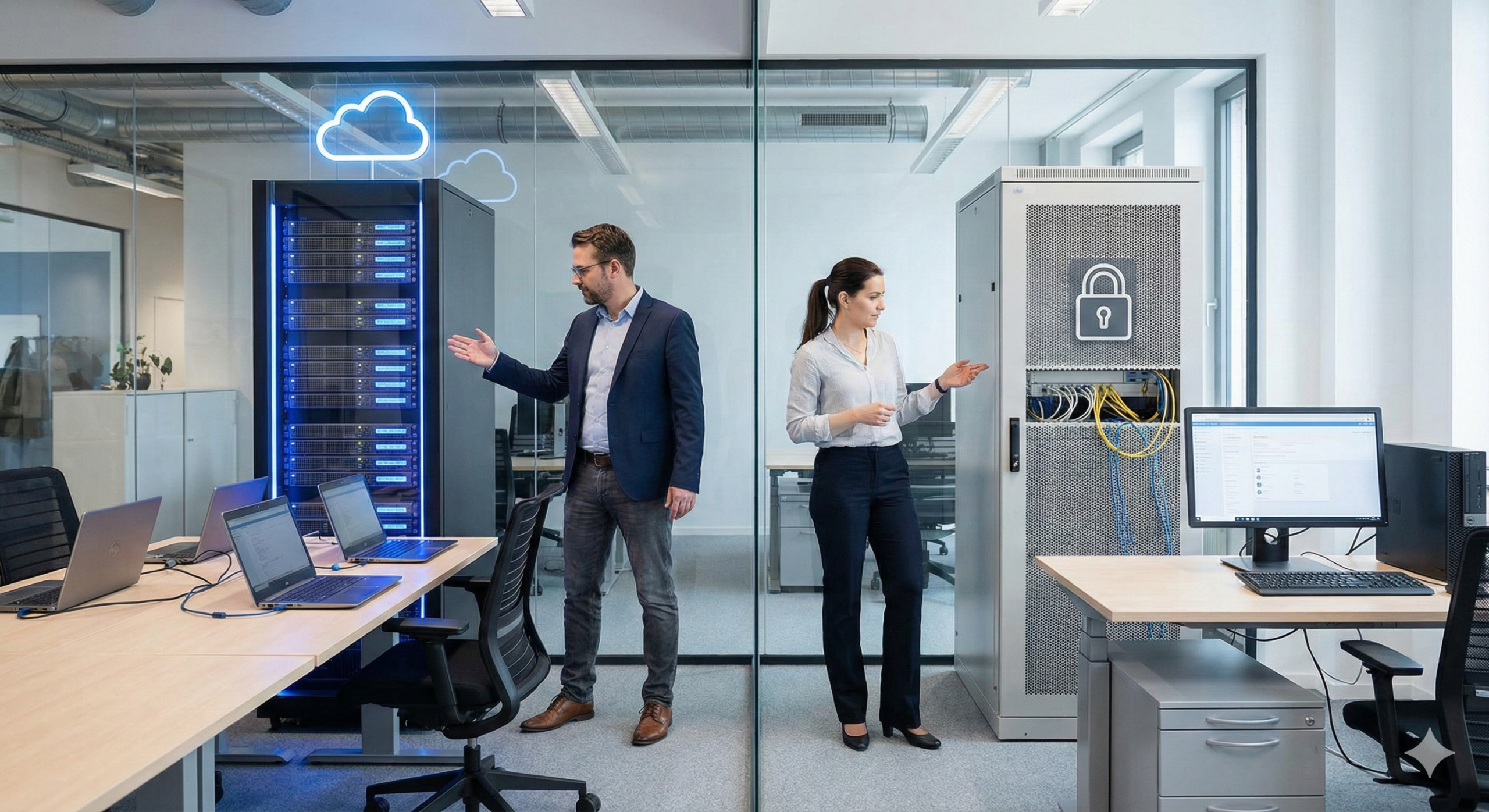
On-Premise (On-Prem): This is the traditional model. Your company purchases physical hardware—servers, storage devices, networking equipment—and keeps it within your own physical location (in a data closet, server room, or a rented space in a data center). Your internal IT team is responsible for everything: power, cooling, maintenance, security patches, and hardware upgrades. You own it.
-
Cloud Computing: Instead of buying hardware, you rent computing resources (processing power, storage, software) from a third-party provider like Amazon Web Services (AWS), Microsoft Azure, or Google Cloud over the internet. The provider manages the physical hardware and infrastructure at their massive data centers. You rent it as a service.
The Case for the Cloud: Agility and Scale
For many growth-focused modern businesses, the cloud is the default choice. Here’s why:
1. Unmatched Scalability This is the biggest advantage for a growing company. If you land a huge new client and need double the server capacity tomorrow, you can provision it in the cloud with a few clicks. With on-premise, you’d have to order new servers, wait for delivery, install them, and configure them—a process that can take weeks. The cloud lets you scale up and down instantly, so you only pay for what you use.
2. Predictable Costs (OpEx over CapEx) On-premise requires significant upfront capital expenditure (CapEx) to buy hardware that will eventually become obsolete. The cloud operates on an operating expenditure (OpEx) model. You pay a predictable monthly fee, freeing up cash flow for other vital parts of your business like marketing or hiring.
3. Flexibility and Mobility The cloud is built for the modern, hybrid workplace. Your team can access applications and data securely from anywhere with an internet connection, on any device. This is far more complex and costly to set up with traditional on-premise infrastructure.
4. Reduced IT Burden Your IT team no longer needs to spend their time replacing failed hard drives or worrying about server room air conditioning. The cloud provider handles the hardware maintenance, allowing your internal team to focus on strategic initiatives that drive business value.
The Case for On-Premise: Control and Compliance
Despite the cloud’s popularity, on-premise infrastructure isn’t dead. For some businesses, it remains the superior, or even necessary, option:
1. Ultimate Control and Customization When you own the hardware, you have complete sovereignty over your environment. You can configure it to meet highly specific performance requirements or run legacy applications that might not play well in a standard cloud environment.
2. Stringent Data Compliance For highly regulated industries like healthcare, finance, or government defense, strict laws may dictate where data must physically reside. Keeping data on your own servers gives you absolute certainty about its location and security perimeter, simplifying compliance audits.
3. Performance and Latency For applications that require real-time processing with near-zero delay (like controlling machinery on a manufacturing floor or high-frequency trading), the extra milliseconds it takes for data to travel to the cloud and back can be unacceptable. Local servers provide the lowest possible latency.
4. Long-Term Cost Predictability While the cloud is great for variable workloads, for highly predictable, steady-state workloads that run 24/7 for years, buying the hardware outright can sometimes be cheaper over a 5-year period than paying monthly cloud rental fees.
The Hybrid Middle Ground
For many businesses, the answer isn’t “either/or”—it’s both.
A hybrid cloud approach combines on-premise infrastructure with public cloud services. You might keep your sensitive customer database and legacy ERP system on on-premise servers for security and control, while using the cloud to host your public-facing website, run data analytics, and handle temporary spikes in traffic. This offers a pragmatic balance of security, performance, and flexibility.
How to Choose?
When evaluating your options, ask these key questions:
-
What is our growth trajectory? Is it explosive and unpredictable (Cloud) or steady and planned (On-Prem)?
-
What are our compliance needs? Do we have legal requirements to keep data physically secured on-site?
-
What is our budget model? Do we prefer large, one-time capital purchases or smaller, ongoing monthly operational costs?
-
What is our internal IT capability? Do we have the staff and skills to manage physical hardware effectively?
