

Small businesses are often prime targets for cyberattacks because they typically have fewer defenses and smaller IT budgets than large corporations. In 2026, with AI-driven threats operating at an unprecedented scale, relying on a basic firewall and standard antivirus software simply doesn’t cut it anymore. Hackers know that smaller operations are lucrative targets for data theft and ransomware.
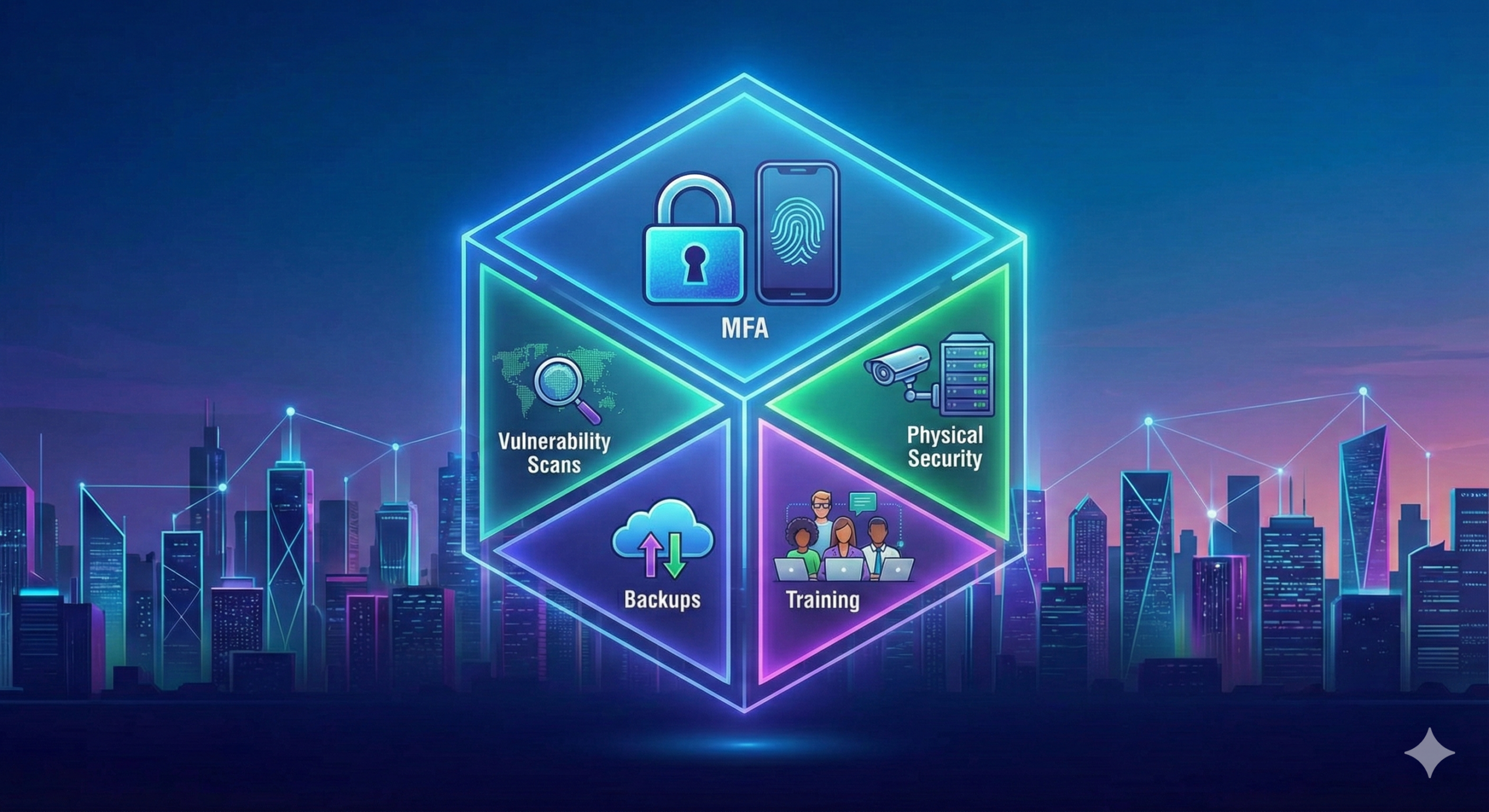
Building a resilient defense doesn’t require an enterprise-level budget, but it does require strategic focus. Here are five foundational cybersecurity practices you need to implement to protect your business this year.
1. Implement Multi-Factor Authentication (MFA)
Passwords alone are no longer a viable security strategy. With the rise of AI-powered credential stuffing and automated password-cracking tools, a standard password can be compromised in seconds.
MFA adds a critical layer of defense by requiring users to provide two or more verification factors to gain access to a resource—typically something you know (a password) and something you have (a code sent to your phone or generated by an authenticator app). Even if a hacker manages to steal an employee’s password, MFA stops them dead in their tracks, preventing unauthorized access to your email, financial systems, and client data.
2. Regular Employee Training
Your digital perimeter is only as strong as the people operating within it. Human error remains the most exploited vulnerability in any organization.
Today’s phishing attempts and social engineering tactics are highly sophisticated, often utilizing generative AI to craft flawless, highly personalized emails that mimic vendors or company executives.
-
Move beyond annual training: Switch to continuous, bite-sized micro-learning sessions.
-
Run simulations: Regularly test your team with simulated phishing campaigns to keep them on their toes.
-
Establish protocols: Ensure your staff knows exactly how to report suspicious activity without fear of penalty.
3. Physical Security
It is easy to get hyper-focused on digital firewalls and forget that physical access to a device often equates to total system access. Integrating modern surveillance and physical security with your digital protocols is essential.
An unattended, unlocked computer terminal or a stolen laptop can easily bypass the most expensive cybersecurity software. Ensure that your physical premises are monitored with high-quality IP surveillance cameras on a secure, segmented network. Additionally, enforce strict policies regarding visitor access, screen-locking protocols, and the physical tracking of all company-issued hardware.
4. Automated Backups
Ransomware attacks—where malicious actors encrypt your data and demand payment for the decryption key—are one of the most devastating threats to a small business. The ultimate failsafe against ransomware is a robust, automated backup strategy.
If your systems are locked down, you shouldn’t have to negotiate with cybercriminals; you should simply be able to wipe the infected machines and restore your operations from a clean backup.
-
Follow the 3-2-1 Rule: Keep three copies of your data, on two different media types, with one copy stored securely off-site or in the cloud.
-
Use immutable backups: Ensure your backups cannot be altered or encrypted once written.
-
Include everything: Whether it is securing your financial records, customer databases, or backing up the core files and custom plugins of your business’s WordPress site, those backups must run automatically and be tested regularly for integrity.
5. Routine Vulnerability Scans
Cybersecurity is not a “set it and forget it” endeavor. New vulnerabilities are discovered daily in the software and hardware businesses rely on.
Routine vulnerability scanning involves using automated tools to sweep your network, devices, and web applications for known security flaws. Outdated software is an open door for automated attacks. Regularly scanning your infrastructure—including verifying that your CMS, custom themes, and server environments are fully patched—helps you identify and close security gaps before hackers can exploit them. Pair these scans with a strict patch management policy to ensure critical updates are applied immediately.
